Why voice diaries
A diary study asks the same people the same few questions, again and again, close to the moment they’re about. Caracal lets them answer by speaking or writing, so the answer can sound the way they would tell a colleague.
So, the test data. Once we plotted the failures by lot it was obvious.
A senior engineer I trust said it felt wrong, and I couldn’t argue. Data came second.
Trust the test data over the schedule. I let the date win. It keeps coming up.
Asking later changes the answer
Note 1Repeated, in-the-moment reports reduce the recall bias of global retrospective self-reports and keep answers close to the settings they describe. Shiffman, Stone & Hufford (2008).Most studies of experience ask people to look back: how the term went, why a decision was made. Those answers are real, but they are reconstructions, shaped by everything that happened since.1Note 1Repeated, in-the-moment reports reduce the recall bias of global retrospective self-reports and keep answers close to the settings they describe. Shiffman, Stone & Hufford (2008).
Note 2Larson & Csikszentmihalyi (1983) named the experience sampling method; Bolger, Davis & Rafaeli (2003) review what diary designs can answer that a single survey cannot.Diary methods take the other route. They ask the same questions again and again, close to the moment, so you can see experience as it is lived and how it changes within one person over time.2Note 2Larson & Csikszentmihalyi (1983) named the experience sampling method; Bolger, Davis & Rafaeli (2003) review what diary designs can answer that a single survey cannot.
Why speaking
Note 3Crozier & Cassell (2016) assess audio diaries as a qualitative method for research on work.Some things are easier to say than to write, so each question in Caracal can take a spoken answer, a written one, or either. Audio diaries are an established qualitative method for studying people’s working lives over time, with their own practical questions, which the platform is built around.3Note 3Crozier & Cassell (2016) assess audio diaries as a qualitative method for research on work.
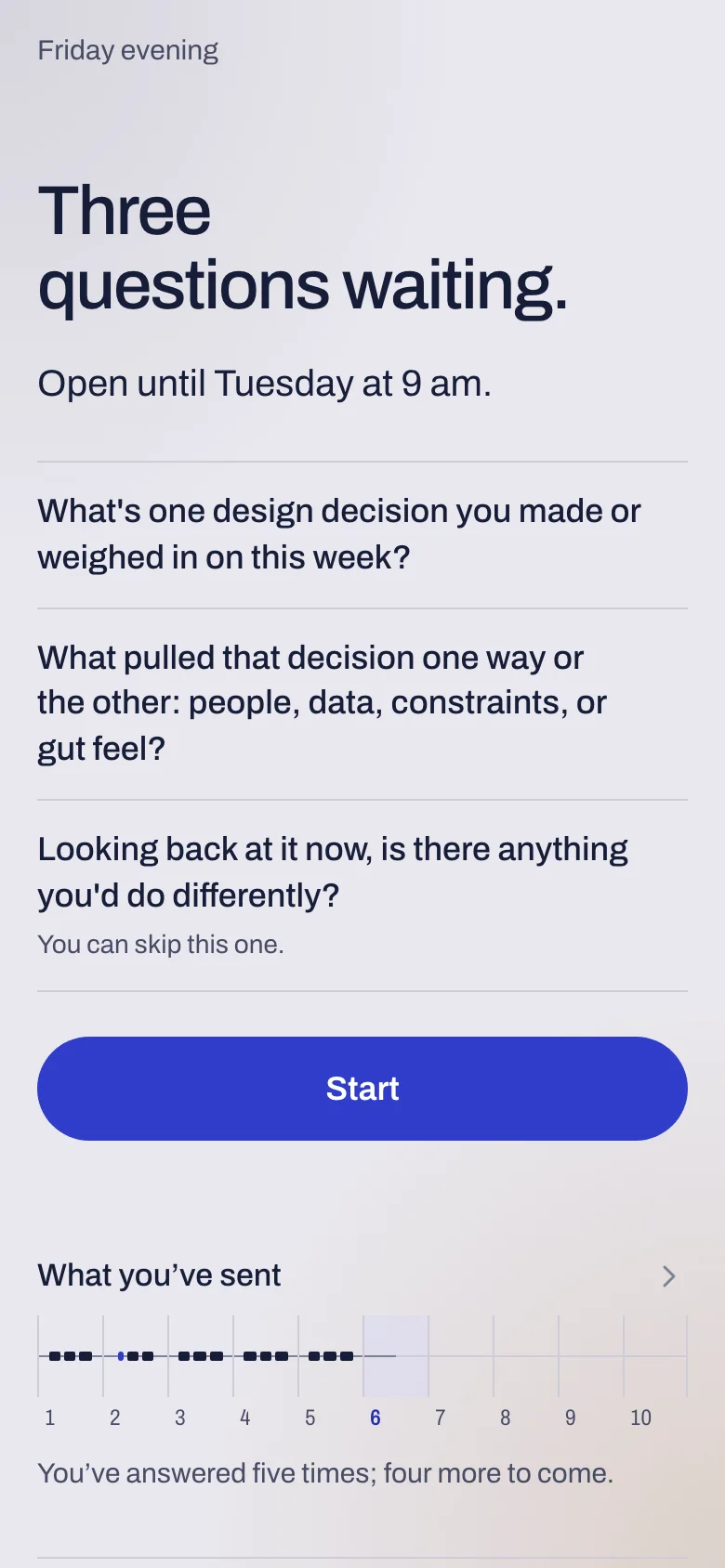
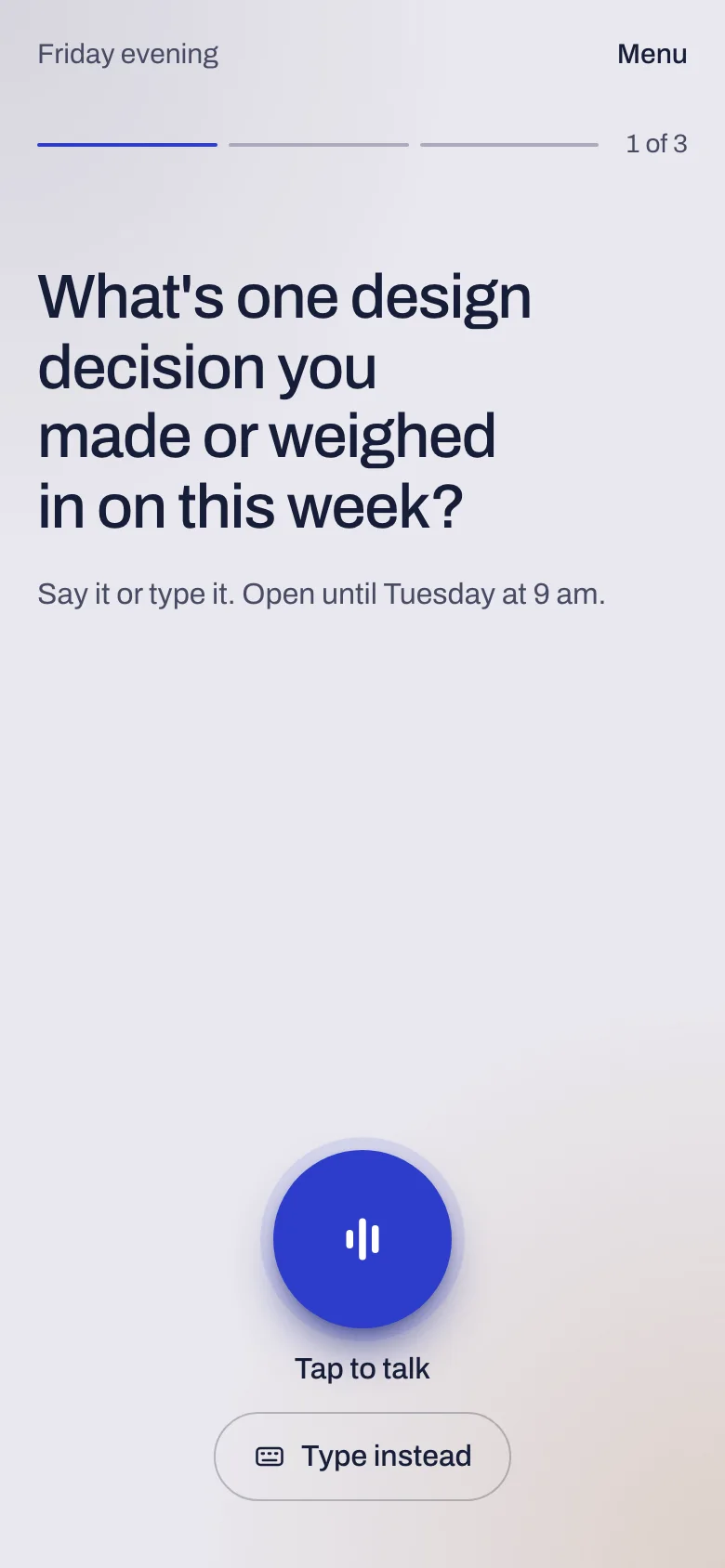
Note 4The participant’s week is shown in Figure 1.Speaking has to be as easy as typing, or people won’t do it every week. Participants open an emailed link on a phone or a computer, tap to talk or type instead, and can listen back or record again before they send. There is nothing to install.4Note 4The participant’s week is shown in Figure 1.
Keeping it up for weeks
Note 5See Figure 2. A check-in can go to each person at most once a week.A diary study is only as good as the weeks people keep answering. The questions are few, they open on a schedule with a window to answer in, and the email that says so never contains their words. The research team sees who has gone quiet and can send a short check-in.5Note 5See Figure 2. A check-in can go to each person at most once a week.

From answers to analysis
Note 6The team adds transcripts from its own workflow; with word timings, Caracal plays them back word by word with the recording.Spoken answers are only useful if they can be found again. Every answer, spoken or written, is a row that can be searched, checked and exported, carrying the consent version its author had agreed to.6Note 6The team adds transcripts from its own workflow; with word timings, Caracal plays them back word by word with the recording.

More about the Response table, or what Caracal offers researchers.
References
- Larson, R., & Csikszentmihalyi, M. (1983). The experience sampling method. In H. T. Reis (Ed.), Naturalistic Approaches to Studying Social Interaction (New Directions for Methodology of Social and Behavioral Science, 15), 41–56. Jossey-Bass.
- Bolger, N., Davis, A., & Rafaeli, E. (2003). Diary methods: Capturing life as it is lived. Annual Review of Psychology, 54, 579–616. doi.org/10.1146/annurev.psych.54.101601.145030
- Shiffman, S., Stone, A. A., & Hufford, M. R. (2008). Ecological momentary assessment. Annual Review of Clinical Psychology, 4, 1–32. doi.org/10.1146/annurev.clinpsy.3.022806.091415
- Crozier, S. E., & Cassell, C. M. (2016). Methodological considerations in the use of audio diaries in work psychology: Adding to the qualitative toolkit. Journal of Occupational and Organizational Psychology, 89(2), 396–419. doi.org/10.1111/joop.12132