Hear how people think, week after week.
Caracal runs longitudinal diary studies in the browser. Participants answer your questions by speaking or writing, on a phone or a computer, with nothing to install. You see who’s answering, read and listen to every answer, and export exactly the data you need.
In development at the IDEEAS Lab and preparing supervised pilots. We are looking for research teams to run them with us.
One answer, from a phone to a row of data.
Follow a single spoken answer through a synthetic study, in the words each part of Caracal holds it in.
Tuesday, 9:00 am
The week’s questions open.
P-014 gets one short email saying three questions are waiting until Sunday night.
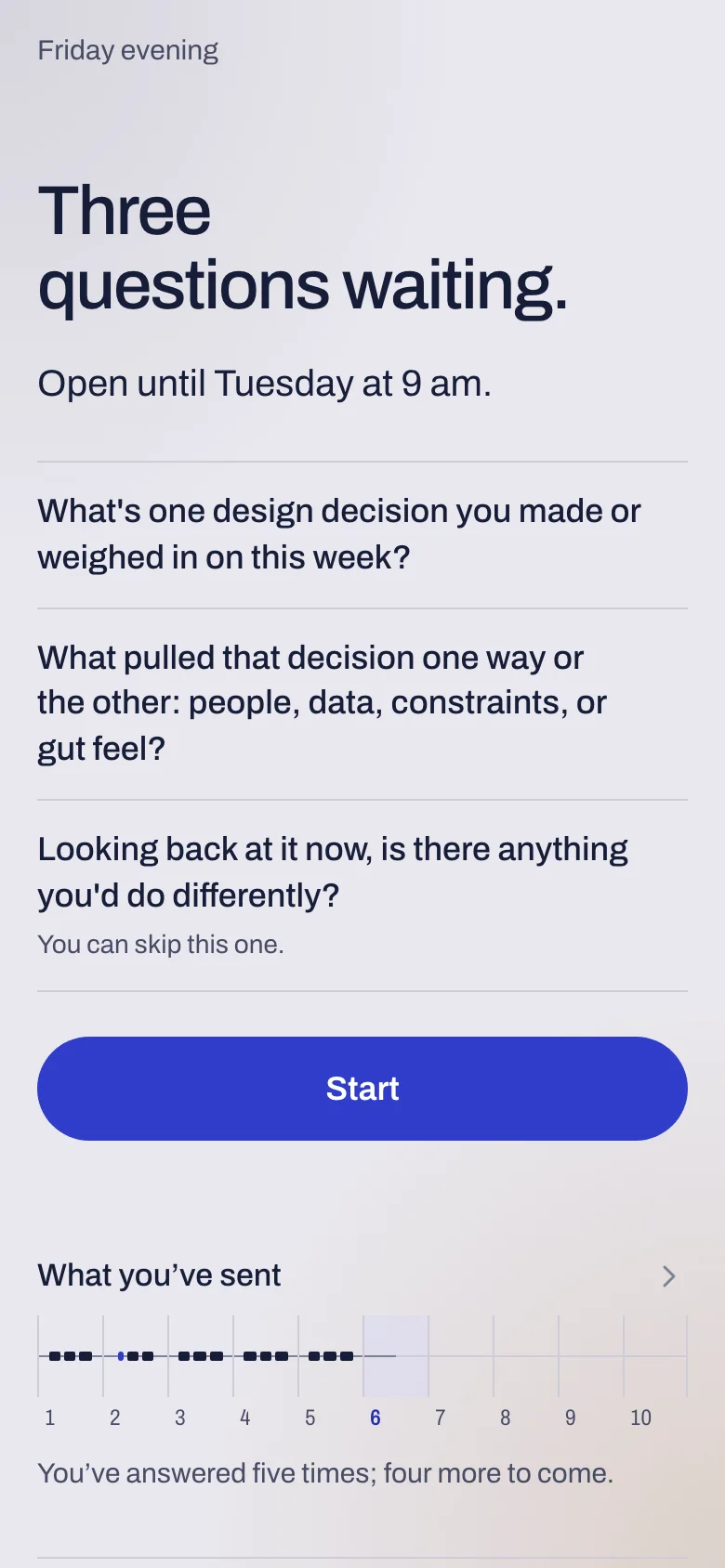
Your questions are open: Design decisions in practiceThere are three questions. It takes about 6 minutes. Answer any time before Sunday, October 18 at 11:59 pm.
Tuesday, 7:40 pm
They answer on the walk home.
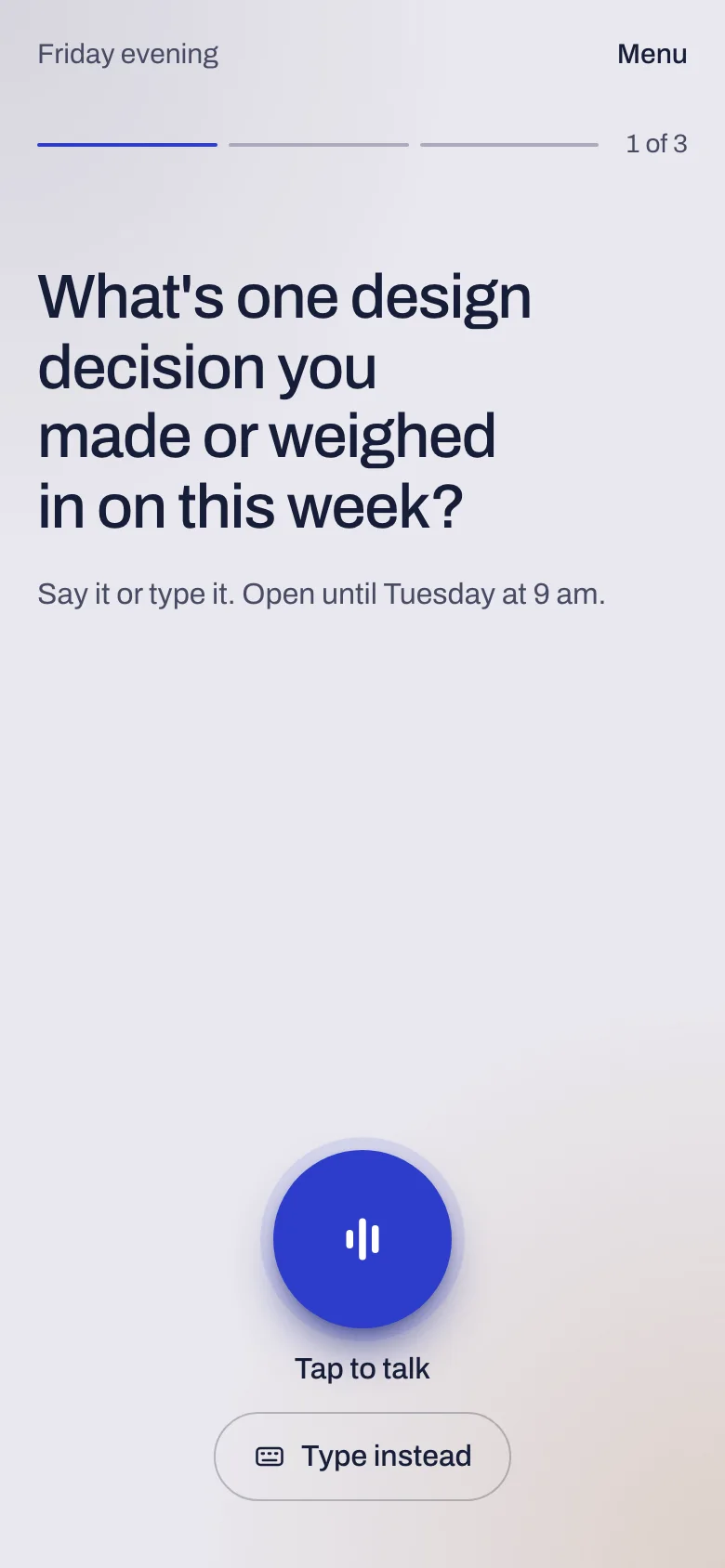
The link opens the question in the browser: no app, no password. They tap to talk; the first take cuts off, so they say it again.
We trusted the prototype over the simulation. The test data was messier, but it was real.
In analysis, months later
It’s found again.
Someone asks when test data outweighed a model. A search lines every answer up on those words, P-014’s among them.
A search for “test data” finds: We trusted the prototype over the simulation. The test data was messier, but it was real.
The export
It leaves as one row.
The CSV holds one row per answer, by code, with the consent version P-014 had agreed to when they spoke.
- participant code
- P-014
- session number
- 6
- consent version at response
- 2
- transcription text
- “We trusted the prototype over the simulation. The test data was messier, but it was real.”
Everyone, every week, on one page.
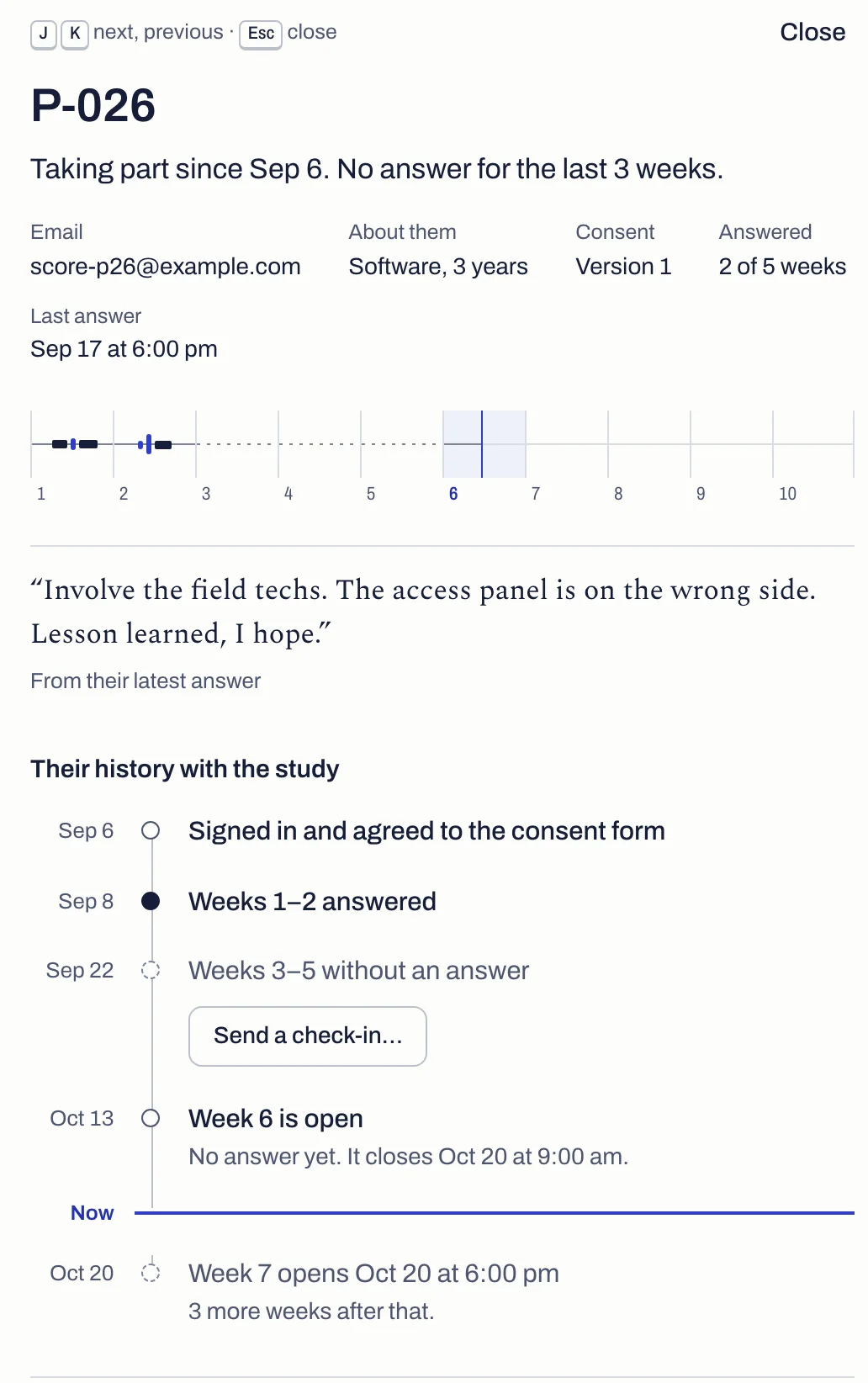
The Score is a study’s home. Each person is a line; each week is a measure; what they said is drawn where they said it.
- The Score shows every person and every week on one page, drawn as a line of what they said.
- It brings forward who needs you: people gone quiet, not yet joined, or who withdrew.
- Send a check-in, the study’s standard note or your own words, at most once a week per person.

Read and listen to every answer.
The reading room puts a week, a person or a question in front of you, spoken answers ready to play beside their words.
- Read and listen by week, by person or by question.
- Add transcripts from your own workflow as a CSV, one row per answer; with word timings, they follow the recording word by word.
- Mark excerpts, highlight words and keep memos on any answer; they travel with the export.

Every answer is data.
The Response table holds one row per answer, in the order the export writes them. Each column heading charts its spread, so a range is one drag away, and a search lines every answer up on the words you searched.

- Export exactly the answers in view as CSV, or the recordings as a ZIP.
- Each row carries the consent version the person had agreed to when they answered.

Nothing to install for the people answering.
Participants open a link and answer. A question can take a spoken answer, a written one, or either.
- Answer on a phone or a computer, in the browser: tap to talk, or type instead.
- Recordings stay on the participant’s device until they are sent (a study can turn this off for shared computers).
- Drafts are kept; a microphone check is one tap away.
- An email says when questions open. It never contains the questions’ words.
Consent, withdrawal and deletion come built in.
The parts of a study an ethics board asks about are the parts Caracal records with care.
- Write the consent text; publish a new version and ask people who agreed to an earlier one to agree again.
- Each person gets a pseudonymous code (P-014); exports use codes, never names.
- Withdrawal is one step for the participant or the team; what they sent is kept under the study’s rules.
- Requests to delete data wait for the team’s decision; an approved deletion runs at the next processing cycle.
Asked in the moment, answered in their own words.
Diary and experience-sampling studies ask people about their lives as they happen, again and again, instead of asking them to remember later. Voice lets them answer the way they would tell a colleague.
Why voice diariesNamed the experience sampling method: asking people about their experience as it happens, repeatedly, in daily life.
Larson & Csikszentmihalyi, 1983Repeated, in-the-moment reports reduce recall bias and add ecological validity compared with global retrospective self-reports.
Shiffman, Stone & Hufford, 2008Assesses audio diaries as a qualitative method for studying work over time.
Crozier & Cassell, 2016
Who it’s for
Researchers
Run a weekly or daily diary study with spoken and written answers, and keep every answer analyzable from the first week.
Participants
What answering is like, what is kept, who can see it, and how to stop or ask for your answers to be deleted.
Ethics boards and data stewards
Consent versions, withdrawal, deletion requests, how recordings are kept, and what an export contains.
Built first for a weekly study of how 50 to 200 practicing engineers make, justify and revisit design decisions. Built at the IDEEAS Lab.
Run a pilot with us.
In development at the IDEEAS Lab and preparing supervised pilots. We are looking for research teams to run them with us. Tell us about your study in a few lines.
Or write to akatz4@vt.edu